All systems
LHDN e-Invoice 2026: Do Clinics, Salons and Spas Need It?
If your small business in Malaysia has annual sales below RM 3 million, you generally do not have to issue LHDN e-Invoices. Since 1 September 2026, e-Invoice is voluntary for these businesses, while businesses at RM 3 million and above still follow LHDN's timeline. You can still opt in through LHDN's MyInvois system.
This guide is for clinic, salon, beauty centre and spa owners. It is general information as at October 2026, not tax advice. Check your own case with your accountant or on hasil.gov.my, LHDN's official site.
Who must issue e-Invoices in Malaysia now?
LHDN brought in e-Invoice in phases, by annual turnover or revenue. Here is its official timeline, updated on 30 August 2026:
| Annual turnover or revenue | Start date |
|---|---|
| More than RM 100 million | 1 August 2024 |
| More than RM 25 million, up to RM 100 million | 1 January 2025 |
| More than RM 5 million, up to RM 25 million | 1 July 2025 |
| Up to RM 5 million | 1 January 2026 |
| Less than RM 3 million | Exempt |
For a small clinic, salon or spa, the last row is the one to check. LHDN uses the turnover in your audited accounts, or the revenue in your tax return if you have no audited accounts.
If you own several sole proprietorships, LHDN adds them all together. The exemption also does not apply if your business is linked to a bigger one. This is when your holding company, a company shareholder, or a related company or joint venture has RM 3 million or more in turnover.
e-Invoice for small businesses in Malaysia: what changed on 1 September 2026
The exemption threshold went up from RM 1 million to RM 3 million, effective 1 September 2026. LHDN says more than 1.1 million businesses benefit.
For exempt businesses below RM 3 million, LHDN's guideline and FAQ say:
- No e-Invoice compliance action or penalty applies to you.
- You do not need to issue consolidated or self-billed e-Invoices either.
- If you already started, you may stop right away, with no application or approval needed.
- You may also carry on voluntarily, which the government encourages.
If your sales later reach RM 3 million, you start on 1 January of the second year after that year of assessment. If you are near the line, or were above it before, plan ahead with your accountant.
What if you choose to issue e-Invoices voluntarily?
Opting in may suit you if company customers often ask for e-Invoices, or your sales are growing towards RM 3 million. If nearly all your customers are walk-ins who never ask, waiting is fine too.
If you do issue e-Invoices, everyday sales work like this:
- Customers who do not need an e-Invoice get a normal receipt, as today.
- You can combine those sales into one consolidated e-Invoice each month.
- Submit it within 7 calendar days after the month ends.
- Any single sale above RM 10,000 needs its own e-Invoice.
- You can cancel a validated e-Invoice within 72 hours. After that, use a credit note, debit note or refund note.
What if a customer asks for an e-Invoice?
If you are exempt and have not opted in, LHDN does not require you to issue e-Invoices. Keep giving normal receipts and invoices, and explain this politely.
If you do issue e-Invoices, a customer can ask for one within the month of the sale. Ask them for:
- Name, plus MyKad or business registration number
- Tax identification number (TIN). Individuals may give their MyKad number instead.
- Address and phone number
- SST registration number, if any
Each validated e-Invoice gets a unique number and a QR code to check its status.
MyInvois Portal or a connected system?
LHDN offers two ways to send e-Invoices. You may use either or both, as long as no e-Invoice is sent twice.
| MyInvois Portal | Connected system (API) | |
|---|---|---|
| What it is | LHDN's own portal, free of charge | Your system sends e-Invoices to MyInvois |
| How it works | A form for each e-Invoice, or a spreadsheet upload | Sent from your bills, with no retyping |
| Suits | Businesses without a connected system | Businesses with many transactions |
LHDN notes that the API route needs upfront investment in technology. A system already connected to MyInvois saves your front desk retyping every bill.
How Techub handles LHDN e-Invoice
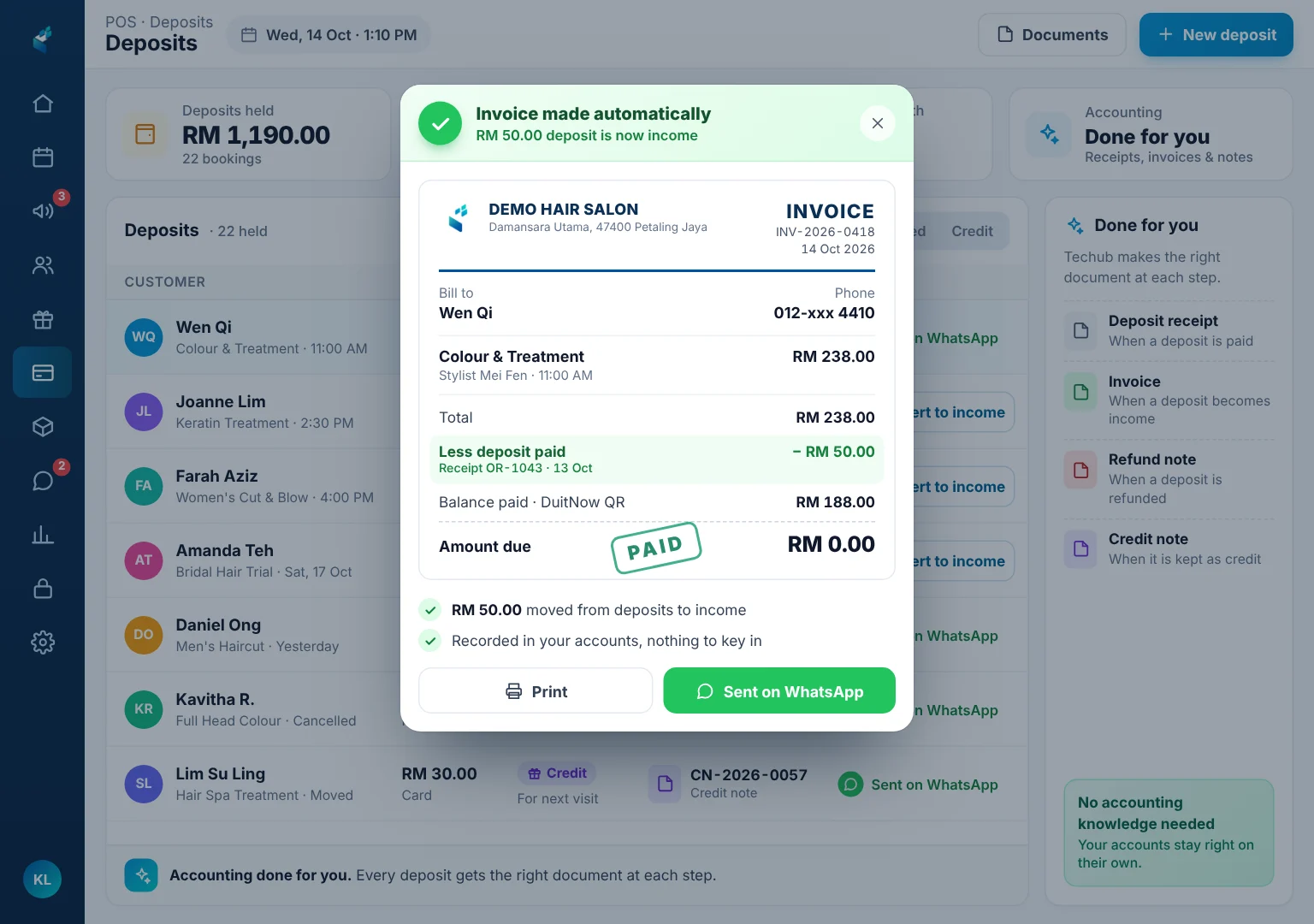
In Techub's systems, e-Invoices are issued from billing and POS, then submitted to LHDN through MyInvois, straight from the system. Each validated e-Invoice comes with its QR code, and records are kept for every invoice.
LHDN e-Invoice is included in our Clinic Management System, Salon Appointment System, Beauty Appointment System and Spa Appointment System. The same systems make invoices, credit notes, refund notes and official receipts for you.
Plans start from RM 99/month per outlet with our Welcome offer (12 months plus 2 months free, only RM 84.86 a month on average) for the first 250 users until 31 Dec 2026, or RM 178 month by month, and new users get the first 3 months free, including installation and staff training. See our technology page and pricing.
Exempt from e-Invoice but still need a normal invoice or receipt? Our free invoice generator makes one with your logo as a PDF in a minute.
Questions people ask
Do I need to issue LHDN e-Invoices if my sales are below RM 3 million?
No, businesses with annual turnover or revenue below RM 3 million have been exempt since 1 September 2026. Group rules can change this, and you may still opt in voluntarily.
Can I stop issuing e-Invoices if I am under RM 3 million?
Yes, LHDN's FAQ says an exempt business may stop immediately, with no application or approval needed. You may also continue voluntarily if it helps your customers.
Is the MyInvois Portal free?
Yes, LHDN provides the MyInvois Portal at no charge. You key in each e-Invoice or upload a spreadsheet, while a connected system sends them from your bills.
See it running in your business
Want to see LHDN e-Invoice working in a clinic, salon, beauty centre or spa system? Book a free demo with us on WhatsApp.
From RM 99/month per outlet · 3 months free