Clinic Management System
Medical Inventory Software for Clinics in Malaysia: Batches and Expiry
A clinic's medicine shelf holds hundreds of items, each with its own batch number and expiry date. On paper or in a spreadsheet, expired stock gets missed, busy medicines run out and a recall can take hours to check. Here is how to keep medicine stock under control, and what medical inventory software should do for you.
This guide is for GP, dental, aesthetic and specialist clinics in Malaysia that dispense their own medicines. It is general information as at October 2026, not legal advice, and the examples are made up.
What the rules expect from a dispensing clinic
The Medical Council's Good Dispensing Practice guideline (MMC, 2025) sets out what doctors who dispense should do. For stock, it comes down to five things:
- Keep a stock list. The doctor in charge is responsible for a stock inventory of the medicines in the clinic.
- Record what you dispense. For poisons under the Poisons Act, the prescription book entry includes the date, a serial number, the medicine and the patient's name. Paper or electronic records are both fine, as long as they can be inspected.
- Lock up controlled drugs. Dangerous and controlled drugs need locked storage and proper records.
- Keep the cold chain. Vaccines and other heat-sensitive medicines go in a pharmaceutical fridge with a thermometer.
- Dispose of expired medicines properly, following the clinic's policy and the law.
Every dispensed medicine also needs a label with the clinic's name and address, the patient's name, the medicine, how to take it and the date.
Track every batch and expiry date
- Record the batch and expiry of every delivery when it comes in.
- First expiry, first out (FEFO): dispense the batch that expires first, even when another batch arrived earlier.
- Set an expiry alert, for example 90 days ahead, so there is time to use the stock, return it to the supplier or move it to another branch.
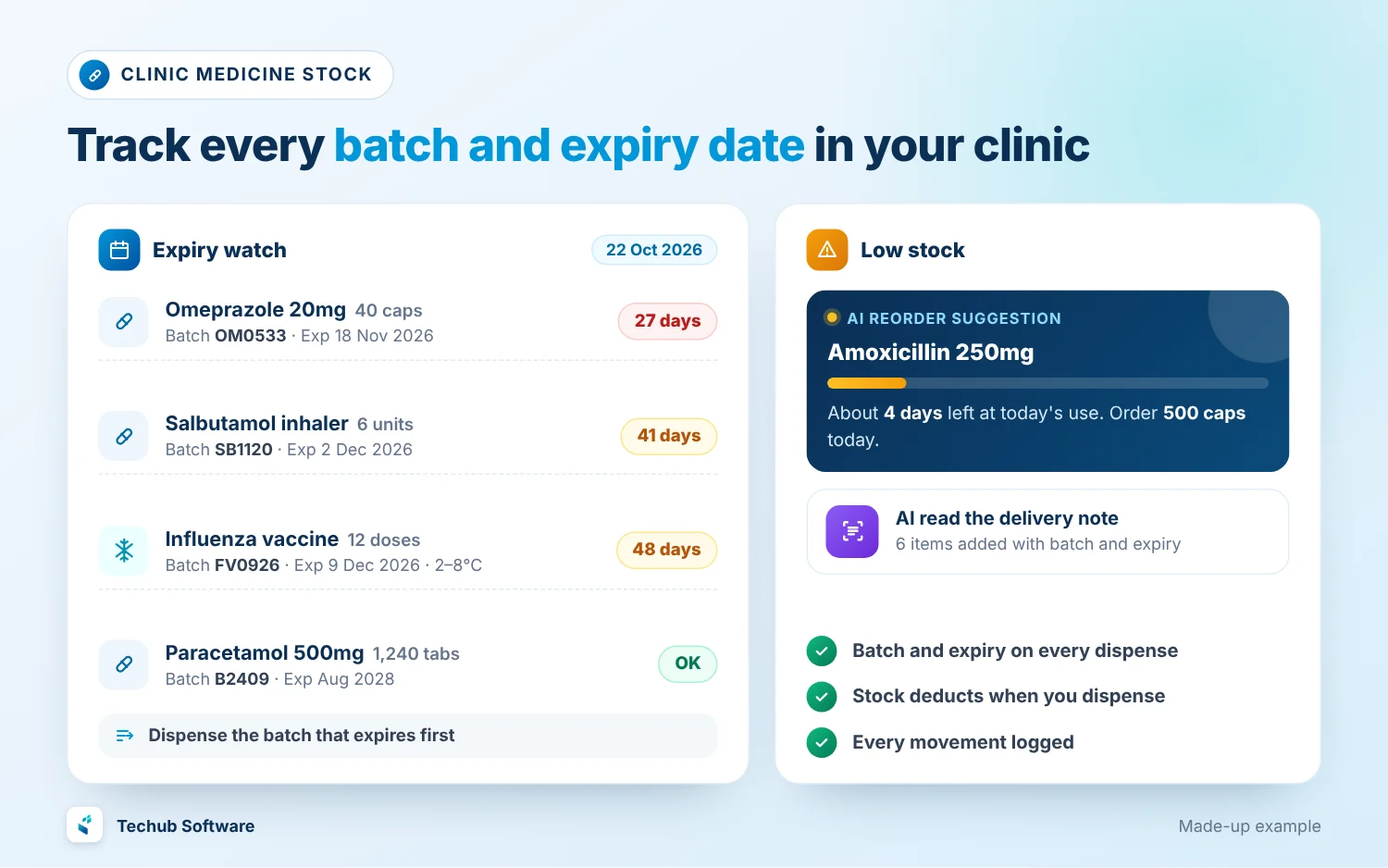
Here is a made-up expiry check on 22 October 2026:
| Medicine | Batch and expiry | What to do |
|---|---|---|
| Omeprazole 20mg | OM0533, 18 Nov 2026 | Dispense first: 27 days left |
| Salbutamol inhaler | SB1120, 2 Dec 2026 | Dispense first: 41 days left |
| Influenza vaccine | FV0926, 9 Dec 2026 | Keep cold: 48 days left |
| Paracetamol 500mg | B2409, Aug 2028 | Nothing to do |
Set reorder levels so busy medicines never run out
A simple rule: reorder level = daily use × (days the supplier takes + a few spare days).
Say your clinic uses 48 capsules of Amoxicillin 250mg a day, the supplier delivers in 3 days and you keep 2 days spare. The reorder level is 48 × (3 + 2) = 240 capsules. With 200 capsules left, you are below that level with about 4 days of stock, so order today: the delivery arrives in 3 days, with a day to spare.
Slow movers matter too. Medicines that haven't moved in 90 days tie up cash and expire on the shelf, so order less of them next time.
Be ready for a recall
When a medicine has a quality problem, the National Pharmaceutical Regulatory Agency (NPRA) or the company that registered the product can recall it. A recall can cover one batch or every batch, so you need to know quickly:
- Which batches you have on the shelf
- Which patients received the affected batch
When the batch is recorded on every dispense, both answers take one search instead of hours of checking cards.
Medicine price display: where it stands
Since 1 May 2025, the Price Control and Anti-Profiteering (Price Marking for Drug) Order 2025 asks private clinics and pharmacies to show medicine prices: a price tag on medicines on display, and a price list for medicines behind the counter.
On 21 May 2026, the High Court stayed its enforcement against private clinics until a judicial review brought by the doctors' association MMA is decided, and the government did not appeal. Whatever the outcome, it helps to keep every medicine's selling price up to date in one place.
A monthly stock take in 5 steps
- Count the shelves, the fridge and the locked cabinet.
- Compare the count with your stock list and find the gaps.
- Check expiry dates. Move anything expiring within 90 days to the front, or plan to return it.
- Record every adjustment with a reason, such as expired, damaged or missing.
- Review the reorder list and the medicines that haven't moved.
What to look for in medical inventory software
- Batch and expiry captured at stock in, without retyping the delivery note
- Stock deducted automatically when the doctor dispenses
- Batch and expiry recorded on every dispense, for recalls
- Low-stock and expiry alerts
- Medicine labels printed at the counter
- Allergy alerts before prescribing
- Every stock movement logged, with who did it
- Stock for each branch, with transfers between them
- Reports that open fast, even with years of records
How Techub helps
Techub's Clinic Management System comes with AI stock control. Snap the supplier's delivery note and AI reads the items, batch and expiry. Stock deducts when you dispense, every movement is logged, and you get low-stock and expiry alerts. Medicine labels print straight from your label printer.
Plans start from RM 99/month per outlet with our Welcome offer (12 months plus 2 months free, only RM 84.86 a month on average) for the first 250 users until 31 Dec 2026, or RM 178 month by month, and new users get the first 3 months free, including installation and staff training. See pricing for details.
Choosing a system? Read our guide to choosing a clinic management system.
Sources: MMC Good Dispensing Practice (2025), NPRA on quality reports and recalls, Malay Mail on the price display order, The Star on the High Court stay, The Star, 2 August 2026.
Questions people ask
What is medical inventory software?
Software that tracks a clinic's medicines and supplies: what comes in, what is dispensed or used, and what is left, with batch numbers and expiry dates. Good systems deduct stock when a doctor dispenses and warn you before items run out or expire.
How do clinics track medicine expiry dates?
Record the batch number and expiry date when stock comes in, then use expiry alerts, for example 90 days ahead. Dispense the batch that expires first, and check expiry dates at every monthly stock take.
What does FEFO mean?
First expiry, first out. You dispense the batch with the nearest expiry date first, even when another batch arrived earlier, so less stock expires.
Do clinics in Malaysia need to keep dispensing records?
Yes. The Medical Council's Good Dispensing Practice guideline says dispensed medicines must be recorded, including the Poisons Act prescription book details such as the date, the medicine and the patient. Records can be on paper or electronic, as long as they can be inspected.
Must private clinics display medicine prices?
The Price Marking for Drug Order 2025 has asked for price display since 1 May 2025, but on 21 May 2026 the High Court stayed its enforcement against private clinics until the doctors' judicial review is decided. Watch for news on the case.
How often should a clinic do a stock take?
Once a month is a good habit for most clinics, with expiry dates checked at the same time. Busy medicines and the locked cabinet can be checked more often.
See it running in your business
Want batch and expiry tracked for every medicine, with low-stock alerts? Book a free demo with us on WhatsApp.
From RM 99/month per outlet · 3 months free